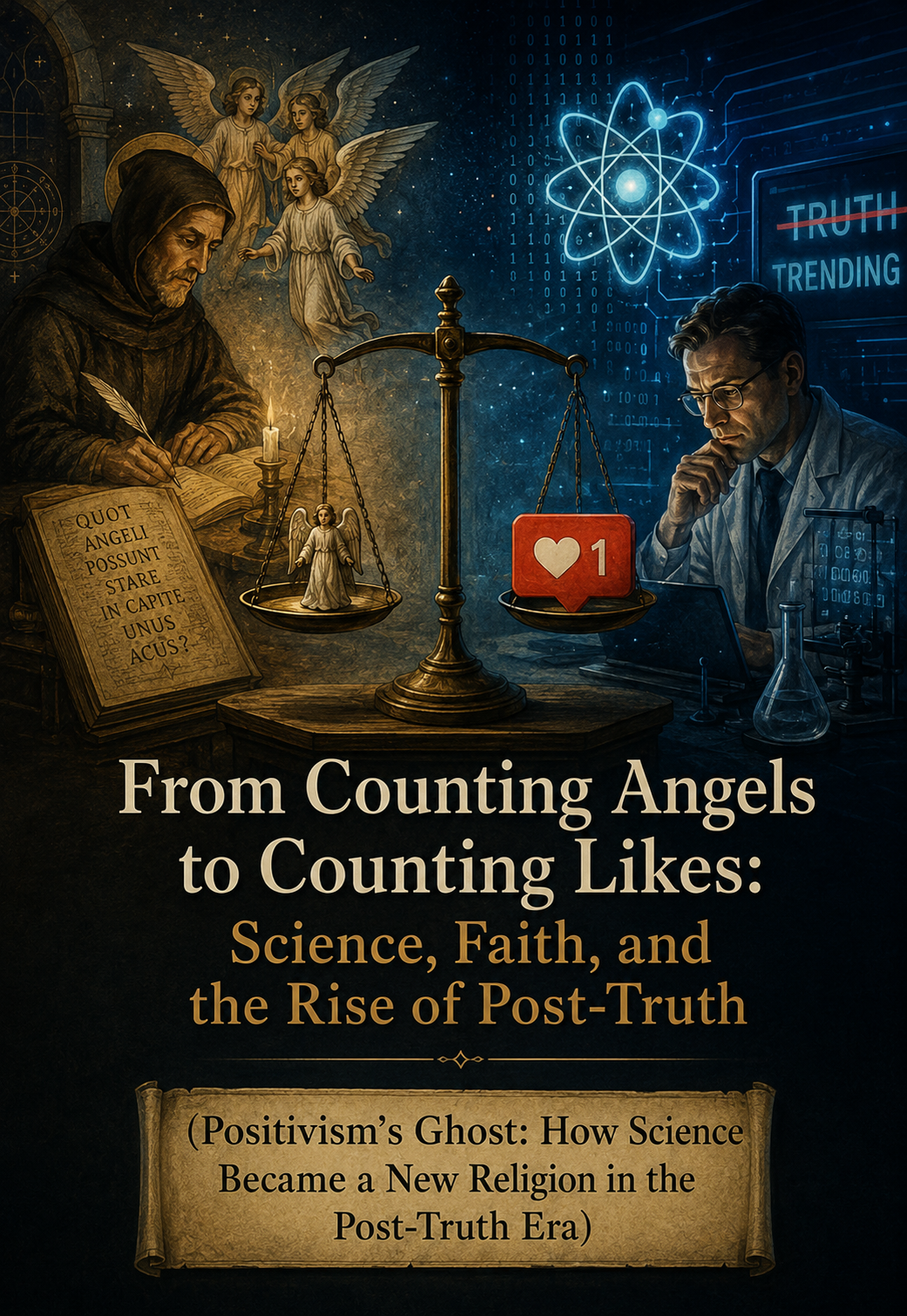
The earliest form of scientific knowledge was religion, emerging at a time when early thinkers had no formal methods and relied solely on hypotheses shaped by their desires and mystical conceptions of how the world should be structured. The earliest religious inquiries were remarkably similar to modern scientific ones in nearly every aspect — except for their subject matter.
For example, Thomas Aquinas, in his Summa Theologica, examines the question of whether multiple angels can simultaneously occupy the same space. This religious approach has persisted throughout history, influencing even modern scientific inquiry. Every scientific hypothesis, to some extent, carries an element of faith — a legacy inherited from religious thought. Here are three examples of modern scientific concepts that remain unproven, relying on a form of intellectual "faith": the multiverse hypothesis, mathematical Platonism, and string theory. Whenever you read about Mathematical Platonism or String Theory, it's hard not to think of those medieval scholastics from old jokes, seriously debating how many angels could comfortably fit on the head of a pin. Modern scientists have clearly inherited from medieval monks this remarkable penchant for passionately discussing things they can neither observe nor ever prove.
The Enlightenment and the Displacement of Religion
Since the Enlightenment, religion has gradually lost its influence in philosophy and science. A well-known anecdote illustrates this shift: when Napoleon asked the French astronomer and mathematician Pierre-Simon Laplace why God was not mentioned in his Treatise on Celestial Mechanics, Laplace famously replied:
"Je n'ai pas besoin de cette hypothèse" — "I have no need for that hypothesis."
One of the last significant attempts at integrating religious elements into philosophy was Immanuel Kant's transcendental idealism. He developed a system of thought positioned between realism (which holds that the world exists independently of our perception) and idealism (which asserts that the world is a construct of our perception). According to Kant, human cognition is shaped by "pure reason", an innate framework that precedes experience and organizes knowledge into fundamental categories. He argued that through pure reason, independent of sensory experience, one could resolve synthetic problems.
Kant's idea carried a deeply theological undertone, because the only conceivable source of knowledge prior to experience is God. This aligns with Kant's famous statement:
"I had to deny knowledge in order to make room for faith." — Immanuel Kant
Since knowledge prior to experience cannot be verified empirically, it inevitably remains a matter of faith. Kant introduced a "divine" limitation on human understanding — the concept of the thing in itself (Ding an sich), which exists beyond our perception and remains fundamentally unknowable. This paradox led to criticism from his contemporaries, who asked: If the thing in itself cannot be known, then how did Kant himself come to know about it?
Positivism and Its Discontents
Eventually, with the Industrial Revolution, religious influences began to be seen as an obstacle to progress. Auguste Comte (1798–1857) founded positivism, a philosophical approach that emphasized empirical science and rational inquiry as the only legitimate sources of knowledge. Comte believed the sciences form a hierarchy (mathematics at the base, then physics, chemistry, biology, and culminating in sociology) and formulated core positivist principles: empirical observation, scientific method as guide, law-like regularities, and rejection of metaphysics.
Comte's positivism had a progressive social vision — he believed that as societies enter the positive stage, they would achieve intellectual unity and social reform. Subsequent events demonstrated this was merely an illusion. The rapid advancement of science, liberated from the ethical and mystical constraints of religion, contributed to the devastating First World War, where the massive loss of life was largely driven by high-tech weaponry.
After the war, logical positivism of the Vienna Circle emerged, owing its birth to the final sentence of Ludwig Wittgenstein's Tractatus Logico-Philosophicus (1921):
"Wovon man nicht sprechen kann, darüber muss man schweigen." (What cannot be spoken about must be kept silent.)
This phrase defined the ideology of the movement, which became radical empiricism, formulated in the "verification principle": a proposition is meaningful only if it can be definitively verified by empirical observation or is analytically true (true by definition).
However, almost immediately, this principle encountered a problem, wittily described by the logical atomist Bertrand Russell in Human Knowledge: Its Scope and Limits:
"Our lives are full of expectations which we usually only become aware of when they fail. Suppose you see half a horse at the moment when it comes round a corner; this may interest you very little, but if the second half turns out to belong to a cow rather than a horse, you will in all likelihood experience a state of extreme surprise which will be almost boundless. It must be admitted that such an occurrence is logically quite possible."
Indeed, the statement "all swans are white" holds meaning only as long as no black swan is found. The empirical method of inductive knowledge through enumeration of observed cases cannot be considered reliable.
Popper, Kuhn, Feyerabend
Logical positivism was aided by a critical rationalist Karl Popper, who, in contrast to the verification principle, proposed the principle of falsification: a theory is scientific only if it can be tested and potentially refuted. If there is a possibility of finding a black swan, then it is meaningful to assert that all swans are white.
This criterion also applies to entire scientific doctrines. For example, Marxism cannot be falsified because one cannot clearly imagine a scenario in which the class struggle definitively ends — thus it does not meet Popper's standard of scientific falsifiability. In contrast, theories that can be tested and potentially disproven — like Einstein's theory of relativity — are considered genuinely scientific. Popper's key principle: if a theory passes many tests, it isn't verified, only "corroborated" and held tentatively. No theory can be considered definitely true.
However, the verification principle itself could not be verified, since it was not a phenomenon of nature but merely a philosophical claim about language. Moreover, the supposed rationality of the positivists was further undermined by Gödel's Two Incompleteness Theorems (1931):
- First Incompleteness Theorem: In any sufficiently developed formal system, there exist true statements that cannot be proven within that system.
- Second Incompleteness Theorem: No such system can prove its own consistency.
Criticism of positivism continued when Willard Van Orman Quine, in his 1951 paper "Two Dogmas of Empiricism," formulated further objections. The logical positivists inherited from Kant the distinction between analytic (true by definition) and synthetic (confirmed by experience) judgments. Quine rightly pointed out that any analytic judgment consists of elements that are not themselves analytic. For example, to prove the statement "All bachelors are unmarried," one must first know from experience who bachelors are and what marriage means. Similarly, all arithmetic operations, which Kant considered analytic, are actually not, since understanding them first requires learning arithmetic.
By the 1960s, logical positivism gradually dissolved. Philosophers Thomas Kuhn and Paul Feyerabend not only criticized the positivist approach but called for a reconsideration of the very attitude towards science.
Thomas S. Kuhn in The Structure of Scientific Revolutions (1962) noted that the scientific community is extremely conservative, profoundly influenced by social and psychological factors, and does not recognize discoveries that go beyond established stereotypes. Alternative theories are not considered because they don't fit the reigning paradigm's rules.
Paul Feyerabend took positivist criticism even further. In his 1975 book Against Method, he argued that science cannot have any fixed methodology and advocated "epistemological anarchism."
"Anything goes!" — Paul Feyerabend
He claimed science is not inherently superior to other modes of knowledge such as myth or religion, and even argued that "science is a most aggressive and dogmatic religious institution." In books like Science in a Free Society (1978), he argued that different cultures may have different truth systems and we have no absolute reason to rank science above ancient myth, except by our own parochial standards.
Postmodernism and the Construction of Truth
In the 1980s, postmodernist thinkers like Jean-François Lyotard and Michel Foucault argued that science is not the mirror of nature but a particular narrative deeply shaped by social, linguistic, and power dynamics. Lyotard presented science as socially constructed and as one knowledge system among many, with no claim to ultimate validity. He noted two major metanarratives that guided modernity:
- that knowledge (science) is progressively leading us toward total truth and human emancipation, and
- that history is moving towards freedom and enlightenment.
Lyotard described knowledge in postmodern societies as splintered into multiple language games and contexts. Science is just one "language game," with its own rules, but it does not have a privileged claim to represent Truth outside those rules.
"Truth isn't outside power… truth is produced by virtue of multiple constraints and induces regular effects of power… each society has its regime of truth, its 'general politics' of truth: the types of discourse it accepts and makes function as true." — Michel Foucault
A typical example of Lyotard and Foucault's concept of power-biased postmodern science is Elon Musk's influence and activity. He uses science for his ventures (SpaceX, Tesla, Neuralink) to promote techno-utopianism, positioning science as the solution to humanity's crises — a legitimizing discourse consolidating corporate and political influence. By owning X (Twitter), he controls narratives, amplifies right-wing voices, and influences political discourse.
This meta-narrative approach has advanced to the point where, unlike positivists who claimed that a successful experiment reveals a fact of nature, constructivists now argue that the validity of an experiment depends on the authority of the experimenters. This raises the question: does truth established in this way remain truth, or does it become something else entirely?
One notable example highlighting how easily the academic community can be misled was the Sokal affair in 1996, when physicist Alan Sokal successfully published a deliberately absurd article, "Transgressing the Boundaries: Towards a Transformative Hermeneutics of Quantum Gravity," in the humanities journal Social Text. He later revealed his hoax to expose postmodern academia's tendency to adopt meaningless scientific jargon. A similar but broader attempt, "Sokal Squared" (2017–2018), involved Peter Boghossian, James Lindsay, and Helen Pluckrose, who submitted numerous nonsensical papers to respected journals, again revealing ideological bias and vulnerability to pseudointellectual content in contemporary scholarship.
Post-Positivism and the Recovery of Science
This devastating approach to science was not halted but slightly tempered by the post-positivist reaction. Thinkers like Popper, Kuhn, Imre Lakatos, and Larry Laudan moved beyond the naive verifications of early positivism without embracing full relativism. Here are some of the main post-positivist principles:
- All theories could be disproven by future observations; none could be known as absolutely true; our picture of the world is always incomplete.
- A hypothesis isn't verified or falsified outright; rather, evidence raises or lowers our degree of confidence. Peer review, replication, and community consensus is crucial in warranting scientific knowledge.
- Contemporary philosophy of science often treats theories as models of the world rather than one-to-one mirrors. Theoretical terms are human constructs that may only apply in certain domains or under certain approximations.
- Science advances by solving problems rather than approaching truth in a straightforward way.
- Lakatos's research programs: Scientists work within research programs that have a "hard core" of fundamental assumptions and a "protective belt" of auxiliary hypotheses that can be adjusted. A progressive research program predicts novel facts and expands, whereas a degenerating one only patches itself to accommodate known problems.
The Rise of Post-Truth
After all these post-positivism observations, it was quite natural to expect a new form of knowledge — and it came. We call it post-truth. Post-truth describes a cognitive state where emotions and beliefs override facts, making factual refutation nearly impossible. Philosophers have long noted this: the Duhem-Quine thesis suggests any theory can be shielded from contradiction with enough added assumptions — explaining why flat-earthers in space might dismiss their experience as an AI-generated illusion.
Classical epistemology focuses on individual knowledge, but post-truth is a societal condition. In a complex world, no one can be an expert in everything, so people rely on social knowledge shaped by groups, institutions, and shared values. Truth depends less on evidence and more on affiliations, trust, and community narratives. This is why certain political claims, no matter how false, are embraced by specific groups. If a public figure declares that immigrants eat cats and dogs, some will believe it — not from malice, but because they trust the source. Ironically, such a figure might even run a social network called Truth, reinforcing the post-truth cycle.
The rise of social media has dismantled the epistemic structures that once defined the "normal world" of the 20th century. Previously, reputable media, universities, and research institutions shaped knowledge, refining it over time. Today, expertise has eroded, replaced by Twitter-like platforms where popularity — not accuracy — drives discourse, fragmenting our understanding of truth.
By 2025, AI also raises questions about whether discovery is uniquely human and highlights biases in machine learning, where flawed data can reinforce systemic errors. While AI reshapes epistemic practices, it hasn't replaced human judgment — only shifted it to designing, fine-tuning, and monitoring AI, demanding new frameworks to ensure sound knowledge production.
References
Aquinas 2006: Aquinas, Thomas. Summa Theologica. Aquinas Institute, 2006.
Ayer 1936: Ayer, A. J. Language, Truth and Logic. London: Gollancz, 1936.
Comte 1853: Comte, Auguste. The Course in Positive Philosophy. London: Chapman, 1853.
Feyerabend 1975: Feyerabend, Paul. Against Method. London: New Left Books, 1975.
Foucault 1980: Foucault, Michel. "Truth and Power." In Power/Knowledge. New York: Pantheon, 1980.
Kuhn 1970: Kuhn, Thomas S. The Structure of Scientific Revolutions. 2nd ed. Chicago: University of Chicago Press, 1970.
Lakatos 1970: Lakatos, Imre. "Falsification and the Methodology of Scientific Research Programmes." In Criticism and the Growth of Knowledge. Cambridge: Cambridge University Press, 1970.
Laudan 1977: Laudan, Larry. Progress and Its Problems. Berkeley: University of California Press, 1977.
Lyotard 1984: Lyotard, Jean-François. The Postmodern Condition. Minneapolis: University of Minnesota Press, 1984.
O'Neil 2016: O'Neil, Cathy. Weapons of Math Destruction. New York: Crown, 2016.
Popper 1959: Popper, Karl. The Logic of Scientific Discovery. London: Hutchinson, 1959.
Quine 1951: Quine, W. V. O. "Two Dogmas of Empiricism." The Philosophical Review 60, no. 1 (1951): 20–43.
Richardson 2019: Richardson, Alan. "Logical Empiricism." Stanford Encyclopedia of Philosophy, Spring 2019.